Something strange happened at the NCAA Championships last season for Grand Canyon swimmer
Mark Nikolaev.
When he emerged from underwater after the start of his 100-yard backstroke race, Nikolaev was surrounded by competitors and trailing most of them. It was a surprising situation after winning the same race by nearly three seconds at the WAC Championships two weeks earlier.
Now, Nikolaev knows the pool of competition. This time, the GCU coaches adjusted the senior's training. Nikolaev enters this week's NCAA Championships with the second-fastest 100 backstroke time in the nation this season but with little control of the outcome beyond a belief that he can improve in his last meet as a Lope.
"When you swim in the morning (preliminaries), the only thing I think about is I need to qualify for finals," said Nikolaev, who finished one spot outside the eight-man NCAA final last year. "In the afternoon, whatever happens happens. I cannot control how other people swim. If I swim 44 seconds and they swim 40 seconds, what can I do? It's not a game. It's just a race. In a game, you can kind of control what other people do. But, here, you're in your own lane. You can show what you've been doing the entire year. I'm trying to show that."
This season, GCU head coach
Steve Schaffer cut back on Nikolaev's rest for the WAC Championships (one week instead of two to three weeks) to emphasize the NCAA meet more. Beyond that, their speed work has focused more on having success in the 100 backstroke, his forte, while still hoping he can score in the 200 backstroke, where he ranks 22
nd in the nation.
Miniscule improvements with his dolphin kick or a turn could make the difference between being an All-American honorable mention this year and being a finalist vying for a national championship this Friday. He swam the race in 44.71 as a junior and posted a 44.61 in November to rank in the top 10 of fastest 100 backstroke collegiate times ever.
"He was faster at mid-year than he ever was before so we think he can be faster again here at this meet," Schaffer said. "I think he's better in that he's been there once now. He got a little blown away by the speed of everybody he had to race against last year. He's used to being out in front and not having to worry about what's going on beside him. It's not like horses, where you put blinders on them. They're there.
"About 25 to 30 percent of the people at the NCAA Championship improve their times. If he is one of those guys, which I think he's going to be, then he'll be in the top eight racing for a national championship and we'll see how it goes. If we get that far, it'll be a good race."
Schaffer tried to put Nikolaev in races where he saw more competition this season to get him accustomed to being flanked in the water.
"At the NCAAs, there was no single swimmer who was slow," Nikolaev said. "Every single swimmer was extremely fast and that's impressive. It was interesting. It was a psychological thing of pressure. I maybe was expecting too much of myself. Usually, when I come to big meets like that, I usually don't expect anything from me. That's usually a win-win situation. When you don't expect anything, if something good happens, you'll be surprised. If something bad happens, it was just like a rehearsal for the next bigger meet."
With that rehearsal behind them, everyone is optimistic for what Nikolaev, his fellow Russian senior
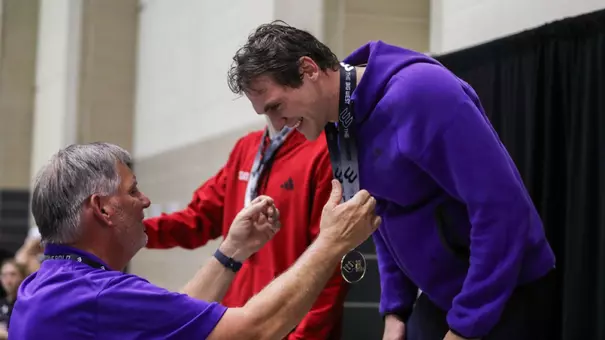
Daniil Antipov and the relays could do in Austin, Texas, this week. If the Lopes crack the top 30 nationally, Schaffer's beard gets dyed purple like after the team won its first WAC championship on March 2.
Nikolaev will continue training at GCU after NCAAs for the World University Games and a potential World Championship spot if Russia qualifies next month. He also will aim to make the Russian team for the Olympics in a year. But this will mark the final time the purple GCU swim cap goes on his head for a college meet.
"It went by so fast," Nikolaev said. "I don't like it. I would like to be here four more years easily. It was a great experience. I loved it all. I improved every year, not only as a swimmer but as a person. And as a team, we improved and we finally won the WAC championship this year. It meant a lot for us as a team and me as well. I'm proud of it."
Nikolaev is grateful for the only Division I program that offered him a scholarship after he sent 200 e-mails expressing interest with NCAA coaches. Schaffer and GCU is even more grateful for his impact on a program that received national attention and NCAA Championship visits because of him.
"He's anybody's franchise player, no matter what sport you're talking about," Schaffer said. "He's the three-time WAC Swimmer of the Year. You don't replace somebody like that. He's not an arrogant guy. He's very humble. He's a quiet leader for the team. A great student. I hope it goes really well for him."
Follow Paul Coro on Twitter: @paulcoro.