
Grand Canyon University Athletics
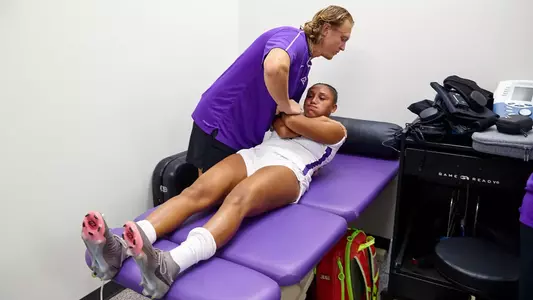
Photo by: David Kadlubowski
Deaf athletic trainer rises with cochlear, doctorate
10/10/2024 12:00:00 PM | Women's Soccer, Sports Medicine, Paul Coro
Stoeppel inspires with ambitious path to playing, working in college sports
Sean Stoeppel started his life in 1999 with one distinction – the first baby to fail a Connecticut hospital's freshly introduced newborn hearing screening test.
He now succeed with many distinctions despite being born deaf.
Stoeppel has navigated mainstream life since he was a 13-month-old receiving a cochlear implant to become a college soccer player, a U.S. Deaf National Team member, a doctoral graduate and a second-year Grand Canyon assistant athletic trainer for WAC championship women's soccer and women's tennis teams.
"I don't want to say I'm one of one, but sometimes I feel like I'm one of one," Stoeppel, 25, said. "I like to share my story because I don't want to be one of one. I want to be one of many, and I want to be one of many who have helped to grab someone else who may be doubting or are unsure about what they are able to do."
 Danbury Hospital, near Stoeppel's hometown of Brookfield, Connecticut, was among about half of U.S. hospitals that tested newborn babies for hearing in 1999, when it was not going to start at Danubry on June 1. Stoeppel was born four days prior, but the hospital started early with the test that put foam pieces in his ears and sought responses to clicking noises.
Nothing. But maybe it was just fluid in his ears, they thought.
A day later, still nothing. But that does not mean deafness necessarily.
Stoeppel underwent subsequent testing with a local ear, nose and throat doctor.
Again, no sign of hearing. They guessed that the equipment was not working because of the loud environment.
"What they didn't know was that the equipment was working," Sean's mother, Susan, said. "Sean is just that deaf."
But the Stoeppels still did not know at that time. He was giving them reason for optimism. He babbled. He lit up each time his sister, Emily, came in the room but actually was being signaled by the floor's vibrations.
"He was so on with everything that we weren't concerned early on," Susan said.
But when Sean was 5 months old, a doctor at Connecticut Children's Medical Center stoicly told the Stoeppels he was deaf, likely because of a virus that Susan suffered during pregnancy.
The unforgiving nerves would never allow him to hear naturally again, and hearing aids would not help because they only amplify weak hearing. Sean had nothing to amplify.
 From that point until he was 18 years old, Sean saw auditory verbal therapist Jessica VanDerFeen weekly and the suggestion of a cochlear implant was made. More often, babies were beginning to receive the electronic device that bypasses damaged inner-ear nerves to send sounds to the cochlear nerve.
At the time, 13-month-old Sean became Yale New Haven Hospital's youngest child to receive a cochlear implant. He received that implant for his right ear – then with a larger device harnessed to his back – and then received another implant for his left side in seventh grade. Advancements made them less intrusive, although his left one was recalled and needed to be replaced for Sean's third surgery a year later.
"The difference was noticeable of the deficiencies that I didn't know I had," Sean said of receiving a second implant. "If you think about a normal microphone that you speak into to amplify sound, it depends on what direction you are coming from to have the microphone pick it up."
 But those early years took more than an implant surgery to navigate Sean's deaf world. Susan never imagined leaving her corporate career as a marketing director of business operations, but she knew she had to dedicate more time to parenting Sean's critical developmental years.
Sean skipped walking to start running at 12 months old, an indication of his active future. But there was significant speech and language work to be done, especially because their small Connecticut town did not have a deaf community. He attended mainstream schools, albeit smaller ones to have a better listening environment.
"It's really amazing what the technology has allowed him to do in his life," Susan said. "Say Sean was born 20 years earlier, he would've been at the American School for the Deaf signing and learning that way."
However, the challenges came socially just as much as vocally or aurally.
"It was an interesting perception growing up," Sean said. "For me, a cochlear implant was the norm, so it took a long time for me to figure out how other people hear."
Although Sean has longer hair now, his closely cropped youthful look revealed the implant(s) to all. Some pointed. Some murmured. Some looked away. Some tried to provoke him.
A woman in a Dunkin' Donuts customer line looked at 5-year-old Sean and said, "That's disgusting ... He should be in an institution," before turning around and leaving. A woman shopping at a Costco stared at Sean and Emily, who is 2 1/2 years older, when both were small enough to sit in a cart together.
"Mommy, she's wearing glasses to see," Emily said. "Does she know that Sean wears that to hear?"
 But even with the contraption creating curiosity, Stoeppel always had his happy place on a soccer field.
His father, Craig, played football and was the starting offensive tackle for the 1987 Syracuse team that went 11-0-1 and finished fourth nationally. But football was among the sports that Sean could not play because of the risk to damaging the cochlear components.
Sean wore a tighter magnet and initially avoided headers for fear of the danger that the device could rip his skin or be damaged. The cochlear occasionally detached as he tried headers, but he or a teammate would pick it up just the same as when an athlete loses a contact lens in action.
He discovered heading the ball was not harmful by the time he was 9. And the sport was helpful.
Like with his life to hear better and avoid surprises, soccer and his position as a center back kept the action in front of him.
"Kids are tough, and they don't necessarily understand differences or make allowances like adults do," Susan said. "He found his acceptance on the field, and that translated into the school. Sports brings you together when you otherwise might not be on common ground."
Driven to succeed in those common areas, Sean thrived academically and athletically. His mother set a standard for him to succeed without excuses the same as any other child in his school. They discovered his other heightened senses with an amazing visual recall, ability to lip read and easily triggered smelling.
Sean's weekly audiologist sessions were life-changing, and his special education services in mainstream schools became minimal by eighth grade.
He was training his ears to listen 14-16 hours per day to a more electronic sound than what most people have. A love for music helped him learn pitches.
With one implant, he walked on people's left side so sound wound not have to travel around to his processor side. With two implants, he noticed the originating point of sounds better but also was activating nerves that went unused for 13 years. Garbled, static sounds eventually clarified.
"The difference was noticeable of the deficiencies that I didn't know I had," said Sean, who has an inner bicep tattoo reading "Hear now. And always."
"If you think about a normal microphone that you speak into to amplify sound, it depends on what direction you are coming from to have the microphone pick it up. Sometimes, I still have to do a 720 (-degree turn) to figure out where the sound is coming from, but I eventually figure it out."
 His soccer elevated to playing collegiately for Division III Endicott and becoming part of the U.S. Deaf National Team.
That still did not come without unusual peril. Taking a hit to the head could be excruciating.
"As athletic trainers, we always ask athletes to rate their pain on a scale from 1 to 10," Sean said. "That's like a 13. The first time I took a shot, I was 12 years old. I was in Pennsylvania for regional finals. I know exactly when and where. You don't forget that type of pain."
The devices, which are replaced every five years for about $3,500, allow him the highest level of function, except for the occasional pause in conversation to replace the batteries.
A phone app controls the volume of his processor, which has various programs to adjust to the types of sounds he is receiving – one-on-one conversation, group settings. There are times where the devices picks up the loudest sound, so background music will drown out the person talking in front of him.
 When he was part of the U.S. Deaf National Team, he was the outlier. He never needed to learn American Sign Language, but he also was in an environment where he took off his cochlear.
"He's been a deaf child in a hearing world, but there he was a hearing person in a deaf world," Susan said. "It was a 180 on everything that he'd grown up with. He'd never had a connection with that side. He had an awakening of a different part of himself."
For his final two years at Endicott, Sean switched from soccer to cross country because of the demands with pursuing an athletic training degree. He continued his education at Indiana State, where he experienced the most challenging two years of his life in a program that allowed him to earn a doctoral degree by age 23.
"I like athletic training because you have a lot of communication," Sean said. "From a very young age, communication was not my strongsuit, and I didn't know it at the time. But to grow and be more social in this field, that was something where I was like, 'I get sports. I get science,' and you get that social aspect."
He accepted his first job with GCU in May of 2023 because of how competitive the Lopes teams are and a campus with the atmosphere and resources he sought. In his first year, he was the athletic trainer for women's soccer and women's tennis teams that won WAC titles and advanced to the NCAA tournament.
 He relates to college soccer players as a former one, but he also is a more empathetic person for any background because of what he endured.
"We always joke around that it's fitting for a one-armed head coach to have a deaf athletic trainer," said Lopes head coach Chris Cissell, who was born without a left forearm or left hand. "He's amazing at his job. One of the things I love about him is he's a bigtime soccer guy. He loves it like the rest of our coaches. He's a got a cool story that he's played at a high level and represented the U.S. Men's National Deaf Team.
"He has instant credibility and respect for overcoming everything that he's overcome in his life by being deaf and also by knowing the man loves soccer and played a high level."
During the final semester of Sean's doctoral program, his final assignment asked what he would achieve in the future to show approach for something from his past.
That pushed him to share his story more, and he has become an ambassador for cochlear implants.
"Some people are nervous to share their story, and that's OK because we have received a lot of abuse, a lot of ignorant comments and hit a lot of struggles," Stoeppel said. "All of that has allowed me to appreciate what I've gone through that I can still function at a high level and that I can be a contributing member of society and play a large role in someone else's life.
"I wouldn't change a thing about where I am today. I'm one of those people who learn from negative experiences. A negative is only a negative if you don't try to make a positive change from it."
He now succeed with many distinctions despite being born deaf.
Stoeppel has navigated mainstream life since he was a 13-month-old receiving a cochlear implant to become a college soccer player, a U.S. Deaf National Team member, a doctoral graduate and a second-year Grand Canyon assistant athletic trainer for WAC championship women's soccer and women's tennis teams.
"I don't want to say I'm one of one, but sometimes I feel like I'm one of one," Stoeppel, 25, said. "I like to share my story because I don't want to be one of one. I want to be one of many, and I want to be one of many who have helped to grab someone else who may be doubting or are unsure about what they are able to do."
Danbury Hospital, near Stoeppel's hometown of Brookfield, Connecticut, was among about half of U.S. hospitals that tested newborn babies for hearing in 1999, when it was not going to start at Danubry on June 1. Stoeppel was born four days prior, but the hospital started early with the test that put foam pieces in his ears and sought responses to clicking noises.Nothing. But maybe it was just fluid in his ears, they thought.
A day later, still nothing. But that does not mean deafness necessarily.
Stoeppel underwent subsequent testing with a local ear, nose and throat doctor.
Again, no sign of hearing. They guessed that the equipment was not working because of the loud environment.
"What they didn't know was that the equipment was working," Sean's mother, Susan, said. "Sean is just that deaf."
But the Stoeppels still did not know at that time. He was giving them reason for optimism. He babbled. He lit up each time his sister, Emily, came in the room but actually was being signaled by the floor's vibrations.
"He was so on with everything that we weren't concerned early on," Susan said.
But when Sean was 5 months old, a doctor at Connecticut Children's Medical Center stoicly told the Stoeppels he was deaf, likely because of a virus that Susan suffered during pregnancy.
The unforgiving nerves would never allow him to hear naturally again, and hearing aids would not help because they only amplify weak hearing. Sean had nothing to amplify.
From that point until he was 18 years old, Sean saw auditory verbal therapist Jessica VanDerFeen weekly and the suggestion of a cochlear implant was made. More often, babies were beginning to receive the electronic device that bypasses damaged inner-ear nerves to send sounds to the cochlear nerve.At the time, 13-month-old Sean became Yale New Haven Hospital's youngest child to receive a cochlear implant. He received that implant for his right ear – then with a larger device harnessed to his back – and then received another implant for his left side in seventh grade. Advancements made them less intrusive, although his left one was recalled and needed to be replaced for Sean's third surgery a year later.
"The difference was noticeable of the deficiencies that I didn't know I had," Sean said of receiving a second implant. "If you think about a normal microphone that you speak into to amplify sound, it depends on what direction you are coming from to have the microphone pick it up."
But those early years took more than an implant surgery to navigate Sean's deaf world. Susan never imagined leaving her corporate career as a marketing director of business operations, but she knew she had to dedicate more time to parenting Sean's critical developmental years.Sean skipped walking to start running at 12 months old, an indication of his active future. But there was significant speech and language work to be done, especially because their small Connecticut town did not have a deaf community. He attended mainstream schools, albeit smaller ones to have a better listening environment.
"It's really amazing what the technology has allowed him to do in his life," Susan said. "Say Sean was born 20 years earlier, he would've been at the American School for the Deaf signing and learning that way."
However, the challenges came socially just as much as vocally or aurally.
"It was an interesting perception growing up," Sean said. "For me, a cochlear implant was the norm, so it took a long time for me to figure out how other people hear."
Although Sean has longer hair now, his closely cropped youthful look revealed the implant(s) to all. Some pointed. Some murmured. Some looked away. Some tried to provoke him.
A woman in a Dunkin' Donuts customer line looked at 5-year-old Sean and said, "That's disgusting ... He should be in an institution," before turning around and leaving. A woman shopping at a Costco stared at Sean and Emily, who is 2 1/2 years older, when both were small enough to sit in a cart together.
"Mommy, she's wearing glasses to see," Emily said. "Does she know that Sean wears that to hear?"
But even with the contraption creating curiosity, Stoeppel always had his happy place on a soccer field.His father, Craig, played football and was the starting offensive tackle for the 1987 Syracuse team that went 11-0-1 and finished fourth nationally. But football was among the sports that Sean could not play because of the risk to damaging the cochlear components.
Sean wore a tighter magnet and initially avoided headers for fear of the danger that the device could rip his skin or be damaged. The cochlear occasionally detached as he tried headers, but he or a teammate would pick it up just the same as when an athlete loses a contact lens in action.
He discovered heading the ball was not harmful by the time he was 9. And the sport was helpful.
Like with his life to hear better and avoid surprises, soccer and his position as a center back kept the action in front of him.
"Kids are tough, and they don't necessarily understand differences or make allowances like adults do," Susan said. "He found his acceptance on the field, and that translated into the school. Sports brings you together when you otherwise might not be on common ground."
Driven to succeed in those common areas, Sean thrived academically and athletically. His mother set a standard for him to succeed without excuses the same as any other child in his school. They discovered his other heightened senses with an amazing visual recall, ability to lip read and easily triggered smelling.
Sean's weekly audiologist sessions were life-changing, and his special education services in mainstream schools became minimal by eighth grade.
He was training his ears to listen 14-16 hours per day to a more electronic sound than what most people have. A love for music helped him learn pitches.
With one implant, he walked on people's left side so sound wound not have to travel around to his processor side. With two implants, he noticed the originating point of sounds better but also was activating nerves that went unused for 13 years. Garbled, static sounds eventually clarified.
"The difference was noticeable of the deficiencies that I didn't know I had," said Sean, who has an inner bicep tattoo reading "Hear now. And always."
"If you think about a normal microphone that you speak into to amplify sound, it depends on what direction you are coming from to have the microphone pick it up. Sometimes, I still have to do a 720 (-degree turn) to figure out where the sound is coming from, but I eventually figure it out."
His soccer elevated to playing collegiately for Division III Endicott and becoming part of the U.S. Deaf National Team.That still did not come without unusual peril. Taking a hit to the head could be excruciating.
"As athletic trainers, we always ask athletes to rate their pain on a scale from 1 to 10," Sean said. "That's like a 13. The first time I took a shot, I was 12 years old. I was in Pennsylvania for regional finals. I know exactly when and where. You don't forget that type of pain."
The devices, which are replaced every five years for about $3,500, allow him the highest level of function, except for the occasional pause in conversation to replace the batteries.
A phone app controls the volume of his processor, which has various programs to adjust to the types of sounds he is receiving – one-on-one conversation, group settings. There are times where the devices picks up the loudest sound, so background music will drown out the person talking in front of him.
When he was part of the U.S. Deaf National Team, he was the outlier. He never needed to learn American Sign Language, but he also was in an environment where he took off his cochlear."He's been a deaf child in a hearing world, but there he was a hearing person in a deaf world," Susan said. "It was a 180 on everything that he'd grown up with. He'd never had a connection with that side. He had an awakening of a different part of himself."
For his final two years at Endicott, Sean switched from soccer to cross country because of the demands with pursuing an athletic training degree. He continued his education at Indiana State, where he experienced the most challenging two years of his life in a program that allowed him to earn a doctoral degree by age 23.
"I like athletic training because you have a lot of communication," Sean said. "From a very young age, communication was not my strongsuit, and I didn't know it at the time. But to grow and be more social in this field, that was something where I was like, 'I get sports. I get science,' and you get that social aspect."
He accepted his first job with GCU in May of 2023 because of how competitive the Lopes teams are and a campus with the atmosphere and resources he sought. In his first year, he was the athletic trainer for women's soccer and women's tennis teams that won WAC titles and advanced to the NCAA tournament.
He relates to college soccer players as a former one, but he also is a more empathetic person for any background because of what he endured."We always joke around that it's fitting for a one-armed head coach to have a deaf athletic trainer," said Lopes head coach Chris Cissell, who was born without a left forearm or left hand. "He's amazing at his job. One of the things I love about him is he's a bigtime soccer guy. He loves it like the rest of our coaches. He's a got a cool story that he's played at a high level and represented the U.S. Men's National Deaf Team.
"He has instant credibility and respect for overcoming everything that he's overcome in his life by being deaf and also by knowing the man loves soccer and played a high level."
During the final semester of Sean's doctoral program, his final assignment asked what he would achieve in the future to show approach for something from his past.
That pushed him to share his story more, and he has become an ambassador for cochlear implants.
"Some people are nervous to share their story, and that's OK because we have received a lot of abuse, a lot of ignorant comments and hit a lot of struggles," Stoeppel said. "All of that has allowed me to appreciate what I've gone through that I can still function at a high level and that I can be a contributing member of society and play a large role in someone else's life.
"I wouldn't change a thing about where I am today. I'm one of those people who learn from negative experiences. A negative is only a negative if you don't try to make a positive change from it."
Monday, September 07
Monday, September 07
Monday, September 07
Monday, September 07