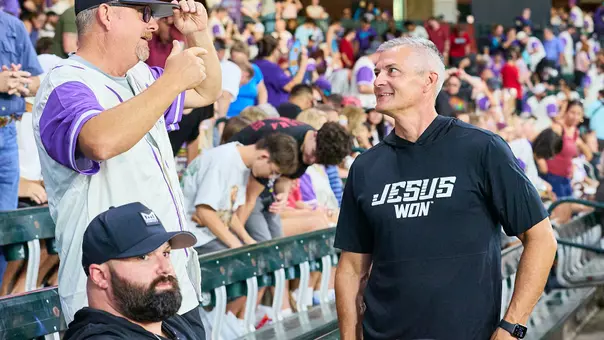
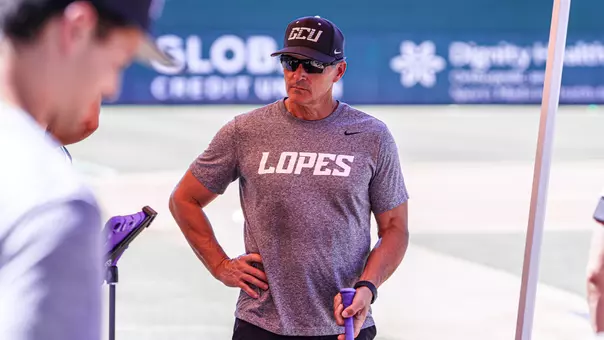
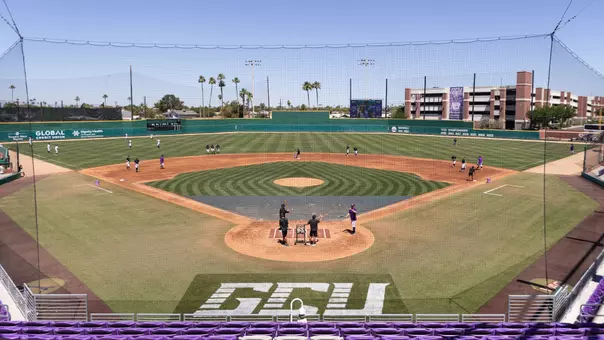
The purple-clad threshold to the next era of Grand Canyon baseball took stage Thursday on campus, where GCU pomp and circumstance welcomed new head coach
Steve Bieser with the interest of media and the support of Lopes staff and supporters.
From a televised welcome to breakout interviews, Bieser painted the scene for his national championship aspirations with the Lopes program and shared more about his trail from a small-town, unrecruited player to a journeyman pro to a head coaching ascension that led him to GCU.

"The numbers don't lie," GCU Vice President of Jamie Boggs said. "
Steve Bieser wins everywhere.
"The bottom line is if you want to maximize your potential in the Major League Baseball draft, come to GCU and come play for Coach Bieser."
Here are parts of Bieser's opening statement, followed by questions and answers with the Lopes' six-time conference champion coach:
Bieser: "I knew right away. Thank you guys so much for having trusted me. I knew right away when I walked out from having the meeting (with Boggs and GCU President Brian Mueller) that this is the place that I needed to be. I'm just so thankful for the trust you put in me.
"We're very blessed to have a family, and that's why I'm here. I want to be part of a family, and I want to be able to express my faith.

"I do have mentors along the way. We all do, people that are very impactful in their life. There's just too many to mention, but I will say there's a couple. The first person that really convince me to come coach at the college level was Mark Hogan. He did many times. He was Southeast Missouri State. That was my alma mater. He was constantly coming back to me year after year, and I was very happy. I was at a private Catholic school in St. Louis, and we really had a lot of success. And finally, I gave in and made that move. But his persistence and the opportunity gave me the start to something that I really enjoyed, and that's developing great young man.
"Two guys in pro ball taught me the valuable lesson of belief and support. Don Blasingame of Phillies, and Mel Roberts was a mentor that I had. It was the first time that I really had somebody believe in me from a baseball standpoint. I came out of high school at 98 pounds. I wrestled at 98 in high school. Nobody wanted me as a baseball player. I walked on, and then I felt finally, after three years of pro ball, these two guys really invested in me. I know how much belief and support matter to the players and coach today.

"And then the last one I'll say is Bobby Valentine. In our clubhouse, you always want to be part of the players. But a lot of the players didn't like the manager out of the locker room, but I was one that really enjoyed him. He had that trust back for me and allowed me to get my first opportunity in the big leagues.
"People ask me, and still ask me right now, why Grand Canyon? And it's very simple for me. Faith and mission alignment. I had a real desire to coach players in a faith-led environment, and I understand that this opportunity is bigger than baseball. And I don't take that lightly. I am super excited for the faith portion of this that we didn't really dive into. The mission alignment, President Mueller talked about that. I came here because for me, I wanted to make it very clear in the interview process that we're coming here to win a national championship. It's not a pipe dream. It's not something that you just say. I truly want to get to work and work extremely hard and build this program into a national contender.

"A couple of things I said was, 'We can do this. We can win a national championship, but there's some things that we really need, and we can do them well. And when I saw both Jamie and President Mueller smile at me, I knew we could do those things. That was super exciting to see that. There's just such a hunger to be the best. And I will tell you it's not for men, but it's for the glory of God.
"Lastly, the current strength of GCU. We have excellent facilities. We have a passionate fan base. We have a commitment to the leadership, the whole leadership. And we are a growing national brand without a doubt. So when you combine faith, excellence and commitment to developing people, GCU becomes one of the most sought-out opportunities in all of college baseball.

"What is our vision for this baseball program? No. 1, develop great men. We're going to recruit to it. First, we get the right people on the bus, and then we get them in the right seats. There will be a high level of character, accountability, servant leadership and a focus on building a culture about relationships. That's what wins in college baseball. The model that we have for baseball is very simple – commit to excellence. To me and to our team, 'Commit to excellence' just means be the best you. We understand that comparisons are the thief of all joy. We're going to have freshmen, and we're going to have seniors. If we have those players on the roster and the freshmen is comparing himself to the senior, we're going to be in trouble. So we're going to make sure that it's not about trying your best. It's about doing your best. Attitude and effort are controllables, and that's a standard. We must, we must have the right attitude every day when wel walk into the ballpark, or when we're walking in life. We must have the proper effort every single day.

"I use what now is going to be tabbed as our 'Lopes EDGE.' I picked this up from (former Cardinals and Royals manager) Mike Matheny many, many years ago. We were teammates. We were friends. When he became a big league manager, and I was at the University of Missouri, I had him come in and talk to our team and he talked about edges. So I didn't steal it all. I just stole an ideal, and I turned it into what we do best. EDGE stands for excellence. It stands for discipleship. It stands for grit, and it stands for earn.
"The excellence – always your best. The discipleship – that is our locker room, brotherhood code that we have. And so when we talk about discipleship, which means to teach and learn the way, that's where the servant leadership comes into play. Each player is going to be a servant leader. We don't care who gets the credit. We want to make sure that we're all doing our part. We talk about every place that we go, everything that we do, we're going to leave that better than we found it, and we're going to stay humble in our success, and we're going to stay resilient through those tough times. Grit – it's simple, we've heard that. Angela Duckworth defines it as passionate perseverance. We all know anything we're passionate about. we love it, we're going to be really committed to it, and we really care for those things that we are very passionate about. We will be very passionate about this program. And the perseverance side of it, that's kind of been me. That's been my DNA, my makeup. It doesn't matter what the situation is. We are going to find a way that, and we're going to fight through those things. The last one – earn. Opportunity is given. I can promise that we will give opportunity. But trust is always earned. We're going to do that through hard work. We're also going to do that through the blood, sweat, and tears that we put in every single day. Any team we have will not give in. They will not give up. EDGE is what drives our competitive excellence.

"The statement that I'd like to make is that we will pursue championships with all of our might. I promise that. But understand that we will never sacrifice our values in the pursuit of winning. It's very important for me to do it with integrity and to do it right.
"I just want us to paint that picture. I want us to have and build the most fan-friendly stadium in all of college baseball. I want us to have the best player development systems. I want us to have the most player-friendly facilities here at GCU. We're not looking to be like anybody else. What we want to be is the standard of college baseball. We want to be a nationally respected program. My promise is simple. We will honor God. We will represent Grand Canyon with excellence and work every day to build a program that makes our university and alumni and the community very proud. That is my commitment to you today."
Q: Take me inside your head. How busy is it in there right now?
Bieser: I'm super-pumped to be here, and that's something we've waited for. Getting here and experiencing this, this is awesome. It's exactly what I envisioned. Everything has been so first-class. We're just getting started, and we just want to continue down that road.
Q: You're in Memphis in 2001. You're a Triple-A guy. You're 33, and a Triple-A guy. What opens your mind to think that I'd like to this someday, or had your mind been opened up through this minor-league journey that you were going to look as soon as you got done.
Bieser: I always knew that I wanted to continue doing something in baseball. At 33 in Triple-A, Carlos Zambrano ran a fastball up and in and broke my wrist. He told me it's time – 33 and still in minor leagues. Probably time to cash it in. My major was math. I eventually wanted to be an engineer, but there's not many baseball schools out there. Having that math degree, I knew I'd go back to coach and teach. It was just something that I had a passion to do. With all the things that I was able to do, I wanted to give that back to people. We're from a very small town (Ste. Genevieve, Missouri), and I created an organization there for all of our kids to have baseball. It was just something on my heart to do.
Q: The high school stop, St. John Vianney (in St. Louis). You won a lot. What do you take still from back then?
Bieser: It is that brotherhood. That is the one thing that we truly had at St. John Vianney High School. We were very connected in our faith. It was a group of guys on a team that were high character. They understood what I stood for. They committed to everything that we wanted to do. Our first state championship was with a group of sophomores. I went in there, and I didn't even care that I wasn't the head baseball coach when I got there. I went in there just to teach. I was the assistant coach. My son followed me there. I just wanted to coach baseball. Our head coach of the varsity team asked me if I'd come up to help them, and we went to the state finals and finished third. At the end of the year, he was like, 'Coach, I'm going to have to go in business with my dad. I want you to take it over.' It was history after that. It was so gratifying to be part of that.
Q: Southeast Missouri, 13 years until they go to a regional. You take them there during your final year there. What did you learn from Cape Girardeau when you stopped there?
Bieser: All of our kids went to Southeast Missouri State. My wife and I both graduated from Southeast Missouri State. It meant a lot to us. That community, it was only 45 minutes from Ste. Genevieve, the small town that we were all from. That community and that piece where people knew us when we were there and they treated us very well and understood how great community has an impact on what we're doing. It was just a phenomenal run. We had a lot of good players and three straight conference championships. We finally busted through that last year. It was a one-bid league. We had to win it to get to it and just had a really enjoyable time there.
Q: How much did the SEC sharpen you?
Bieser: At the University of Missouri, a lot. There's a lot of challenges there. I think part of the reason I got hired was I was able to do things without a whole lot. I wasn't asking for a whole lot, just an opportunity to be successful and competitive there. I feel like we fulfilled that part. Obviously, I was very disappointed that I didn't get a team to regional play there, but understanding the difficulty of getting into a regional at that time and the number of teams they were taking out of the SEC. There were 14 teams in the league, and you had to find a way to be better than at least five of those schools. That was quite a challenge, but I embraced it and I loved the challenge. It's really that never-give-up, that fight. You're always fighting to do your best.
Q: Eighteen wins, Jacksonville State, Year 1. Thirty-four wins, Year 2. This year, 48 wins. What's the how?
Bieser: I do believe that the experiences I've had. I had a real plan. That was built through the high school, through Southeast Missouri State, through our struggles at Missouri. I was going to stick to that plan no matter what. At Missouri, I may have gotten away from my plan a little bit, trying to do it a little bit different than who I am. You can never be different than who you are. That's where I look back at that and say I will never make that mistake again. I have to coach as who I am. We can't be anybody else. People see through that. We went in there with a lot of confidence. The only reason the previous coach left was the portal just raided his team. I was looking at the roster and told my wife, 'I'm not sure why we did this,' because that was a miserable year. It was hard to get through. Great kids. We set the culture in place in Year 1, and then we went out and worked extremely hard on the recruiting trail to build a stronger team. If you follow that second year, we got off to a solid start but you saw it building as the season went. As a team that was predicted to finish last, we get to the conference championship game and lose in extra innings. We carried that momentum into this year. All of our players were bought in. We didn't lose a single guy to the portal in that offseason transition, and that was really what allowed us to win 48 games and be super-competitive all year long.
Q: Talk about development and retention.
Bieser: "Retention is going to be the most important piece to this puzzle. Can we retain the players that were here and then build on top of that? How you retain players is you make sure they understand they have the best coaches in the country, coaches who are completely committed to them to develop them. When they feel that day in and day out, they don't want to go anywhere else. They're just like I was when I played college baseball. I played college baseball to win. I enjoyed my teammates, but I wanted to get to the next level. Every single player that we will coach at GCU will want to play beyond their college years. Whenever they trust you and they know that you love an care of them, they don't want to go anywhere else."
Q: What attributes do you look for when you're recruiting players?
Bieser: "No. 1, let's be honest, when we go to a ball field, you're looking for the most athletic, the guy who's having a lot of success. But that's only a small piece of the puzzle. My wife's been with me for a long time. She could show up at the ballpark and say, 'That player's the best.' Once we find that ability and the skill level, then it becomes for us about the character. Do they fit what we're trying to do? Are they good people? Do they work extremely hard? A great way to get noticed my me and my staff is really when you show up to the ballpark early and you look very intentional about your preparation. Then I'm like, 'This kid understands it. He gets it.' We're going to lock into those guys. It always comes down to character. We're going to talk to your teachers. They don't lie to us. Coaches sometimes lie to us because they want to make sure their player goes to the Division I level, but we're going to talk to people outside of baseball as well and get a real feel for your character."
Q: When people talk about GCU baseball a few years from now, what do you hope that they are going to say about the Havocs support and overall atmosphere of the program?
Bieser: "That is so huge. How do we get the Havocs and people like that to show up and really get people excited about GCU baseball. It's going to be students all over the place. It's going to be fans. It's going to be community. But we have to start somewhere and we need that support. I can't do it alone. We need everybody's support to do this."
Q. Are any of your old team members coming here?
Bieser: "I have to be careful with that because, if they're not in the portal, I can't talk about those players. But I will tell you that I already had some say they're very interested. Everything is so fresh to me. That was 36 or 48 hours ago that I had to talk to our team, and they were very disappointed. But I do know what they understand. They know that I love you. I'm doing this for personal reasons. They understand my faith. They understand that family is very important to me. My guess is we'll have a couple."
Q: Speak to your relationship as a coach to the junior college player.
Bieser: " 'Why junior college?' is what a lot of people ask. But you talk about gritty players, they come out of the junior college level. When they get to a Division I program, they feel so blessed because now all of a sudden we're providing cleats and they don't have to wash their own uniform. They come from a background that they experienced doing a lot with a little. We're going to treat players very well. We're going to make sure that we're talking about nutrition and sleep and all those habits that they need to have to really perform. You have to show your players that you're committed to them and you're doing everything that everybody else is doing. Nobody wants to feel like they're being slighted. Our players will not be slighted here. I can promise you that."
Q: With the elite success you've already had, what was the draw here with the program's tradition and potential?
Bieser: "(Former GCU head coach) Andy Stankiewicz and I played professional baseball together. I came here in 2021 with my Missouri team to play. Andy said you need to come out here and play, and that was a mistake. They were really good. We thought we had one of the best teams that we had that year. We only took one of the (four) games. Seeing firsthand what this program has done in the past and what Andy was able to accomplish in his time here, we think we can do that."
Q: After being at the forefront of using analytics in college baseball, what part does that play with now for data vs. instincts?
Bieser: "Always part of it is learning how to blend it. You can go overboard in the analytics and use it too much. Through experiences, from getting in it early, you are diving into numbers and I'm a numbers guy. I love numbers. But really learning how to understand them and applying them in situations is such an advantage now. Our pitching changes were one of the reasons we were very successful on the mound over the last six, seven years. When you know how your pitcher's fastball moves and his breaking stuff moves and the analytics of a guy's swing that we're playing against, you can really create some good matchups. We stranded a ton of runners this year, and it was about making those moves at the right time. The whole job of a coach is to put players in situations where they can succeed. Having the analytics helps you do that a little bit better."
Q: In a conference with a higher overall ERA partly due to high-elevation locales outside of Phoenix, how do you look at that challenge after having a team that ranked in the top 10 nationally for ERA?
Bieser: "Troy Buckley, who was one of our bullpen coaches when I was in the Pittsburgh organization, and said, 'Bring your hardhat.' He talked about the altitude. One of the reasons we were successful at Jacksonville State was because we had a very spacious field. We had a really good infield defense, so we recruited to that style of pitcher who can get the ground balls. That's what we've got to figure out here. No. 1, how does our field play? And how does the rest of the fields in our conference play because you have to be balanced to win on the road as well. We've been able to put together rosters that can win on the road an be really, really good at our home park usually."
Q: What do you think about learning the Southwest for fertile recruiting ground?
Bieser: "That's something that we're going to lean a lot of people and learn this area quickly and trust the people that we know. The connections that we have with people that are here and the connections that I have with people in professional baseball. I can reach out to scouts and guys who I played with and are here and know the area very well. I'm going to need to lean on them a lot and make sure that we get in the right spot. You can't cover an entire country. You've got to have those connections."
Q: How much does it mean to you that you will be able to integrate faith in your program at Grand Canyon because it is a Christian-oriented university?
Bieser: "When you feel guilty sharing who you are in your faith, it's a hard thing. It's just such a freedom that I feel now and a relief that I can just be who I am, and it's going to be acceptable here."