Photo by: GCU Athletics/Mississippi State Athletics
Polk went from Lope to legend
4/3/2025 11:30:00 AM | Baseball
Share:
'Father of SEC Baseball' began his journey at Grand Canyon
By: Paul Coro
There is a path to the College Baseball Hall of Fame for someone with a playing career that includes 11 hits and a .183 batting average.
After his final Grand Canyon game and graduation in 1965, light-hitting Lopes infielder Ron Polk became a heavy hitter.
Sixty years later, Polk pervades college baseball after an iconic coaching career of 1,373 victories, five Southeastern Conference championships and eight College World Series appearances to be regarded as the "Father of SEC Baseball."
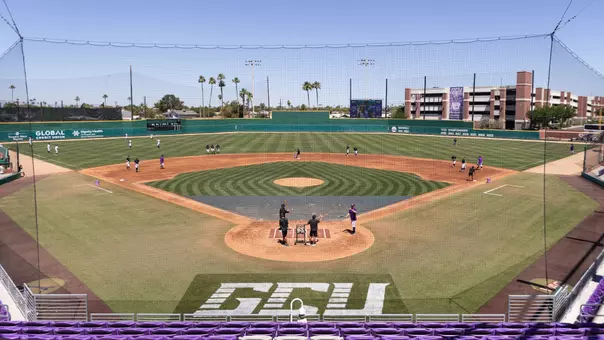
Polk went from the same diamond where Grand Canyon opened its season vs. SEC power Vanderbilt to mining an SEC baseball gem in Starkville, Mississippi. Although he also led Georgia and Georgia Southern to the CWS,
Polk guided six CWS teams during his 30 years as coach at Mississippi State, where his clenched-jaw bronze statue stands before the jaw-dropping Polk-Dement Stadium.
Now a Mississippi State special assistant to the athletic director and broadcast analyst, the 81-year-old knows his impactful life pivoted like a double-play turn at Grand Canyon.
"I decided that if I'm going to be a coach, I'm going to be the coach rather than a coach," Polk said. "I'm going to have to eliminate all my distractions because I didn't play pro ball. My name is nothing. Nobody knows me. From that point, I relied on my work ethic and my solid values that I learned at Grand Canyon." Ron Polk at Grand Canyon
Polk's baseball future formed at age 11 when his family moved to Phoenix because of his mother's asthma. He played baseball at Carl Hayden High School, 4 miles south of GCU, but was cut at Phoenix College and Arizona State.
Grand Canyon catcher Orin Harden, Polk's summer league teammate, shared that legendary Lopes coach Dr. Dave Brazell needed a second baseman because Gary Pullins, who became BYU's baseball coach from 1977 to 1999, left for a church mission.
Brazell offered Polk a partial scholarship, which he accepted and helped the 1964 and 1965 Grand Canyon teams go 40-18 as he earned a physical education degree and became his senior class' vice president.
"Coach Brazell called me into the office after my last season and said, 'Ron, I know you'd like to play pro ball, but you're not quite good enough,' and I said, 'I think you're right,'" recalled Polk, who subsequently received no bites on job-seeking letters and calls. Polk (center) in Varsity Club
Brazell, the namesake of Brazell Field at GCU Ballpark, recommended Polk for an Arizona graduate assistant teaching job. That was a hanging curveball over the plate for Polk's career.
Once in Tucson, Polk offered to shag balls or throw batting practice for Arizona coach Frank Sancet, who made a 22-year-old Polk the Wildcats' third-base coach after firing another coach a week before the season.
"I got back from my first game and thought, 'That was pretty good. I think I'm going to be a coach," Polk said.
After that team reached the 1966 CWS, Polk was an assistant coach for New Mexico and Miami Dade Community College before taking over Georgia Southern as it elevated to Division I with no assistant coaches or dugout roof. In two years, Polk guided Georgia Southern to the CWS.
When Jim Bragan left Mississippi State's coaching job after a 15-20 season, Polk moved in to move mountains. A year into the role, Polk became the SEC's first full-time baseball coach and "the rest is history," he said.
A two-time national coach of the year, Polk assisted U.S. Olympic teams to gold and bronze medals and wrote the comprehensive coaching manual, "Baseball Playbook." He coached 29 Major League Baseball players as collegians, including Will Clark, Rafael Palmeiro and Jonathan Papelbon.
"Coach Polk is one of the classiest people I have met in the college baseball world," GCU baseball coach Gregg Wallis said. "He speaks fondly of his playing days at GCU, and it is humbling to know that such a legend of the game got his start with the Lopes."
Polk woke a sleeping giant in SEC baseball and challenged the NCAA on baseball scholarship limits, a push with effects seen today. Wins translated into Mississippi State stadium upgrades – from adding lights in 1987 to a $68 million renovation in 2019.
"I kept telling presidents and athletic directors, 'Why is the SEC not doing very well in postseason play?'" Polk said. "We had 12 rules that nobody else had – less games, less practice time. I called them the 'Dirty Dozen' and went on the attack."
In 2024, the SEC qualified 11 teams for NCAA regionals, which led to an all-SEC national championship. Eight SEC teams are ranked in the current national top 10.
At Mississippi State, Polk assembled a radio network, secured a television contract and grew a must-see program that has drawn the 19 largest on-campus game crowds in NCAA baseball history.
"If Dave Brazell hadn't talked to Arizona and got me an opportunity there, I'd probably be a junior high baseball coach," Polk said.
At Grand Canyon, Polk rode an old van to games, stayed at undesirable hotels, shared a locker room with the basketball team, dug ditches around the field where the Lopes play today and saw the iconic left-field wall erected to protect 35th Avenue cars from home runs.
After buying a Phoenix-area home for his brother, Polk drove past GC during his annual Valley visits with increasing amazement.
"It's come a long way," Polk said. "I watched a game on TV, and the students really get wild in that place. You mention Grand Canyon now, and people know what it is."






 Polk went from the same diamond where Grand Canyon opened its season vs. SEC power Vanderbilt to mining an SEC baseball gem in Starkville, Mississippi. Although he also led Georgia and Georgia Southern to the CWS,

 A two-time national coach of the year, Polk assisted U.S. Olympic teams to gold and bronze medals and wrote the comprehensive coaching manual, "Baseball Playbook." He coached 29 Major League Baseball players as collegians, including Will Clark, Rafael Palmeiro and Jonathan Papelbon.